Top-tip: Ventricular TachycardiaArticle 11 of 13
Broad complex tachycardias
To have a narrow complex you need functioning specialised conducting tissue, and the cardiac impulse must pass through the AV node normally. All of the SVTs can give a broad complex tachycardia if bundle branch block is present. Much time is spent by cardiologists considering ECGs and asking whether they show VT or SVT with bundle branch block. To the majority of doctors it does not matter. Think of it as VT and you will do little harm in the acute situation. Always treat the patient and not the ECG. So if you see a broad complex tachycardia look at the patient.
Ventricular tachycardia
- Broad complex tachycardia means ventricular tachycardia until proved otherwise
- Likely in patients with established heart disease
- Mainly, but not exclusively, re-entrant mechanism (see figure 6).
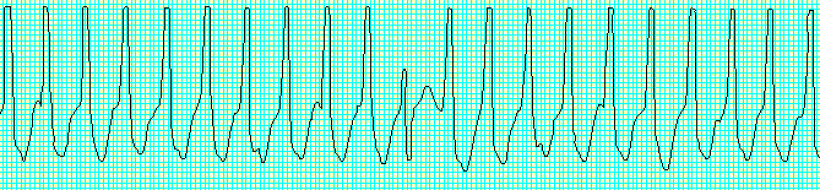
ECG: Broad complex >120 ms; bizarre QRS morphology; no P waves preceding each QRS; abnormal axis; concordant QRS (all point in the same direction); capture or fusion beats may be present (see ECG 7).
Useful treatments: Check the patient; if the patient is pulseless get help and treat as per resuscitation guidelines.
Ventricular fibrillation (VF):
- VF is the rapid, totally uncoordinated contraction of ventricular myocardial fibres
- Causes circulatory arrest; unconciousness develops within 10 to 20 seconds.
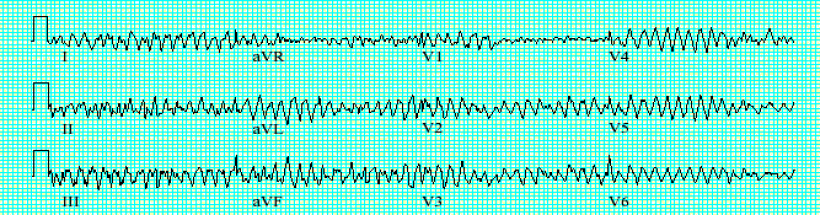
ECG: Irregular, chaotic electrical activity (ECG 8).
Useful treatment: Defibrillation.
ECG 7: Ventricular tachycardia - AV dissociation.
ECG 8: Ventricular fibrillation
The main message about tachycardias is at all times to assess the patient, not treat the ECG. Obviously, ventricular arrhythmias cause most concern as they are most likely to upset the heart's ability to pump blood effectively. But remember that relatively benign rhythms can be devastating if they are fast enough or in a patient with little physiological reserve. If the patient is well there will be enough time to assess even the most serious rhythm disturbance. If the patient is threatened by their heart rhythm then following life support protocols is essential. These give everyone dealing with the situation a proper structure so that they can think and act together.